Posted by Spycor LLC on Jun 2nd 2026
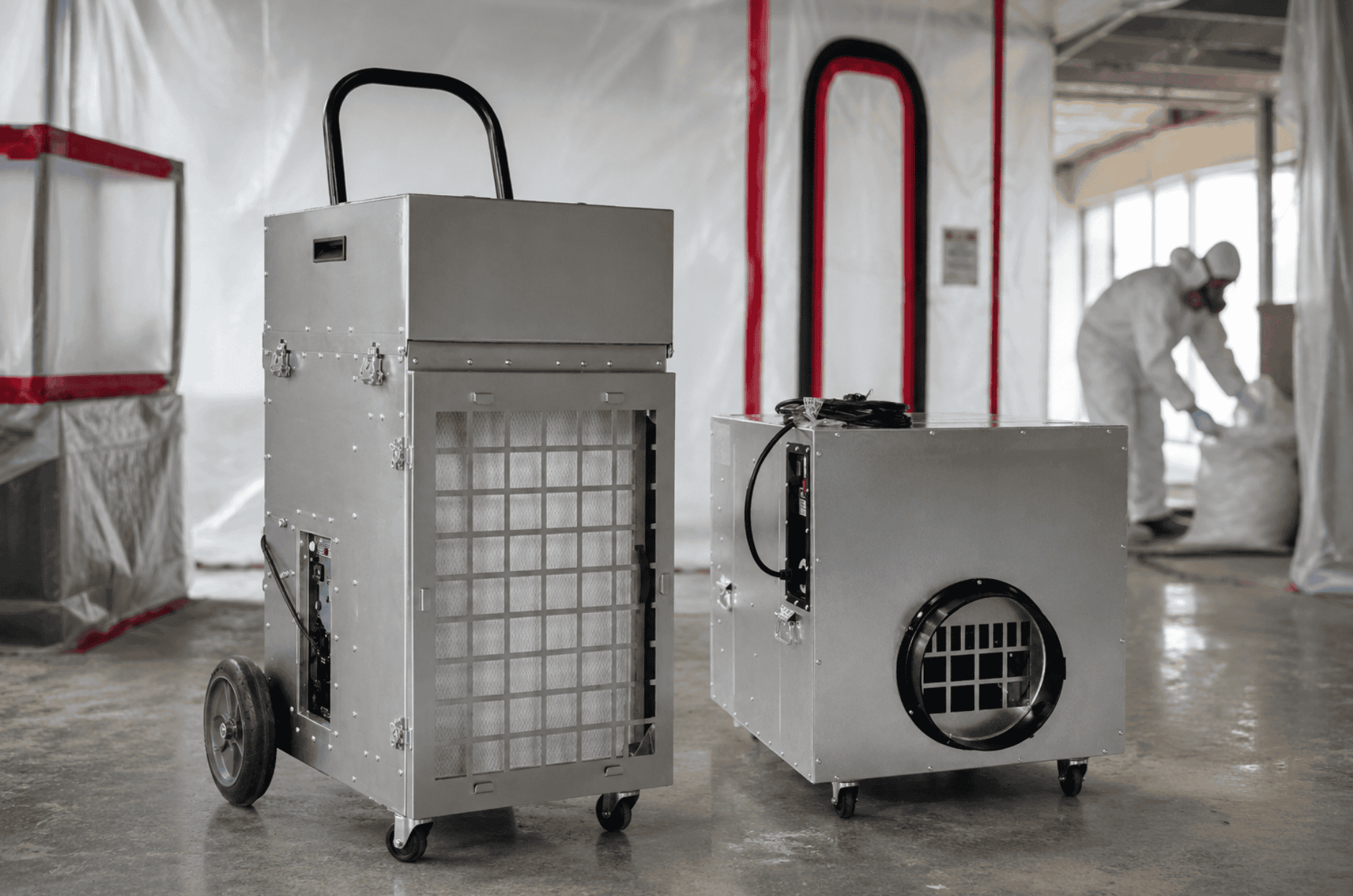
When you're running a large mold remediation project, a commercial asbestos abatement job, or managing air quality on an active healthcare construction site, a standard 500 CFM air scrubber isn't going to cut it. Large jobs — spaces exceeding 5,000 square feet, multi-room containment zones, or high-contamination environments — demand high-CFM air scrubbers that can achieve the required 4–6 air changes per hour (ACH) and maintain consistent negative pressure without flinching.
This guide is written for mold remediation contractors, asbestos abatement professionals, restoration companies, and healthcare facility managers who need to make a purchasing decision based on real performance data — not marketing fluff.
We'll break down what CFM you actually need for large-scale jobs, explain what separates a professional-grade machine from an undersized unit, and review the three best high-CFM air scrubbers available at Spycor Environmental right now.
What CFM Do You Actually Need for a Large Job?
CFM — cubic feet per minute — measures how much air a machine can move. For professional remediation and abatement work, the standard requirement is a minimum of 4 air changes per hour (ACH), with 6 ACH recommended for hazardous environments like asbestos or mold-heavy containment zones.
Here's the formula:
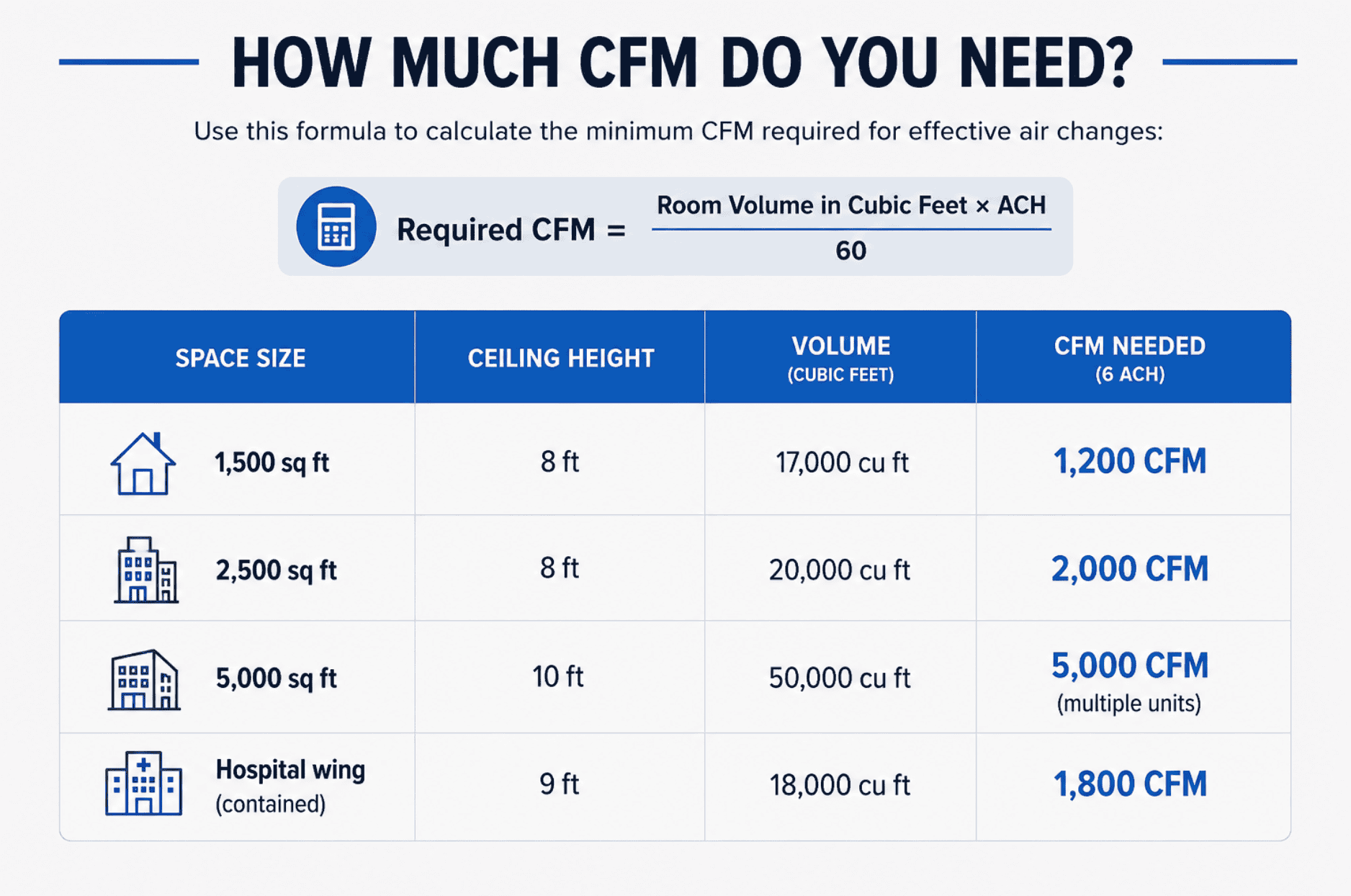
The takeaway: Any commercial job involving a contained space over 1,000 square feet needs a machine capable of at least 1,500–2,100 CFM. Anything under 1,000 CFM is an undersized unit for large jobs — full stop.
What Makes a High-CFM Air Scrubber "Professional Grade"?
Not all 2,000 CFM claims are equal. Here's what actually separates a job-site-ready machine from a unit that will underperform under real working conditions:
1. True HEPA Certification at Rated CFM The HEPA filter must be individually tested and certified at the machine's full operating airflow — not just at a lower speed setting. A filter rated for 99.97% efficiency at 0.3 microns must maintain that rating at 2,000 CFM, not 700 CFM.
2. Three-Stage Filtration System A professional unit runs: Pre-filter (large debris) → Secondary/poly filter (mid-range particles) → HEPA final stage. This layered approach protects the expensive HEPA filter and extends its service life significantly, reducing long-term operating costs.
3. Robust Motor with Thermal Protection Commercial jobs run these machines 24/7. A thermally protected, auto-reset motor prevents burnout during continuous operation — a non-negotiable feature for overnight or multi-day containment setups.
4. Pressure Gauge or Differential Monitor This tells you when filters are loading up and airflow is dropping. On a regulated job site — particularly OSHA-governed asbestos abatement or ICRA-compliant healthcare construction — you need real-time confirmation that the machine is maintaining negative pressure.
5. Portability for the Job Site A unit that's too heavy or lacks wheels becomes a liability on multi-story or multi-room jobs. The best high-CFM machines balance power with maneuverability — fitting through standard doorways and moving without a second crew member.
The 3 Best High-CFM Air Scrubbers for Large Jobs
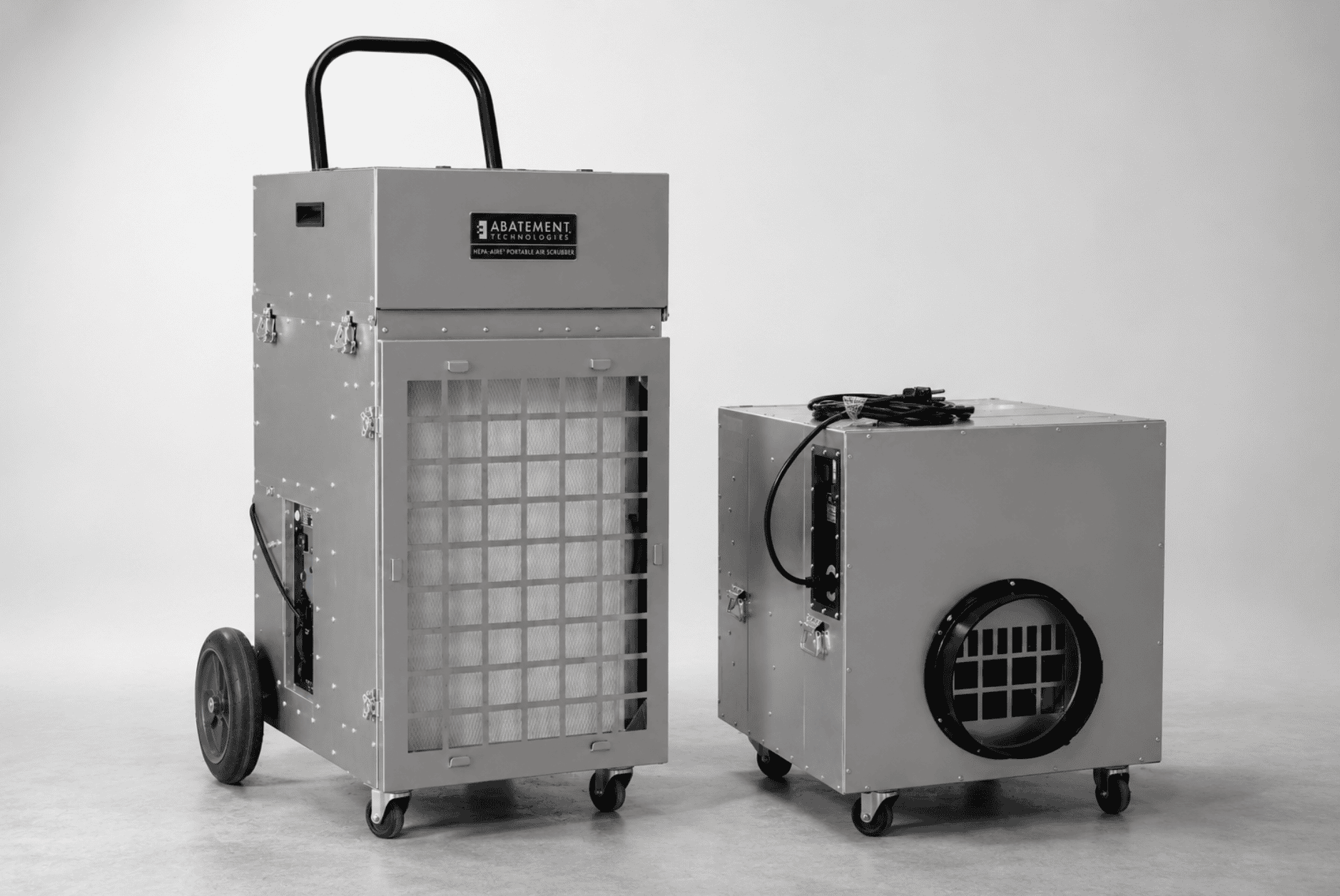
#1 — Abatement HEPA-AIRE PAS2400 Portable Air Scrubber
CFM: 700 (Low) / 2,100 (High) | Best For: Premium large-job performance, occupied spaces, and maximum portability
View the PAS2400 at Spycor Environmental
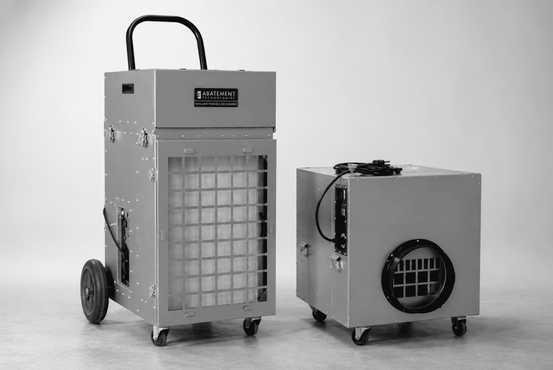
The PAS2400 from Abatement Technologies is the gold standard for contractors who need 2,000+ CFM without sacrificing portability. It's the most compact and maneuverable unit in its CFM class — engineered specifically for jobs where space is tight and performance cannot be compromised.
What makes it stand out:
- 2,100 CFM at full power — handles spaces up to 20,000 cubic feet (approximately 2,500 sq ft at 8 ft ceilings) with 6 air changes per hour
- AT Gold backward-curved blower delivers 75%+ more vacuum power than typical negative air machines at the same CFM rating — meaning real-world negative pressure performance, not just airflow numbers on a spec sheet
- Two-speed operation — run on low (700 CFM) for quiet operation in occupied healthcare or institutional settings; switch to high for aggressive air changes during active abatement
- True HEPA filtration — certified at 2,100 CFM, not just at low speed
- Fits through standard doorways, making it ideal for multi-room hospital or school projects where equipment routing is a logistical challenge
- Weight: 170 lbs including filters
Who should buy this: Restoration companies, abatement contractors, and healthcare facility managers running large commercial jobs who need the absolute best performance and can justify a premium investment. If your team regularly handles projects in the 10,000–20,000 cubic foot range, the PAS2400 pays for itself quickly in efficiency and compliance confidence.
#2 — NCF2000 Negative Air Machine
CFM: 1,400 (Low) / 1,950 (High) | Best For: Best value high-CFM unit for commercial mold and dust jobs
View the NCF2000 at Spycor Environmental
The NCF2000 is the workhorse of the Spycor lineup — delivering near-2,000 CFM performance. For contractors who need serious airflow on large jobs without the premium price tag of the PAS2400, this is the machine to buy.
What makes it stand out:
- 1,950 CFM on high — sufficient for spaces up to 15,000+ cubic feet at 6 ACH, covering most large residential and small commercial remediation jobs
- 1.0 HP motor with thermal overload protection — built for continuous, 24/7 operation on multi-day containment jobs
- Three-stage HEPA filtration at 99.97% efficiency — captures mold spores, asbestos fibers, lead dust, and fine construction particulate down to 0.3 microns
- Pressure gauge for real-time filter monitoring — essential for OSHA and ICRA compliance on regulated job sites
- 24" × 24" × 11.5" HEPA filter — a large filter face means longer service life between replacements, reducing operating costs
Who should buy this: Mold remediation contractors, water damage restoration companies, and construction crews who run frequent large jobs and need reliable high-CFM performance at a price that makes fleet-building practical.
#3 — NCF1800 Negative Air Machine
CFM: 1,250 (Low) / 1,800 (High) | Best For: Budget-friendly entry into the high-CFM category
View the NCF1800 at Spycor Environmental
The NCF1800 delivers 1,800 CFM — well above the 1,500 CFM threshold required for serious large-job coverage — at the most accessible price point of the three. For contractors who are scaling their equipment inventory or need a reliable backup unit, this machine delivers genuine professional-grade airflow without the cost of a premium unit.
What makes it stand out:
- 1,800 CFM on high — handles spaces up to 12,000 cubic feet at 6 ACH
- Galvanized steel housing — durable enough for active construction and abatement job sites where equipment takes abuse
- 1 HP thermally protected motor — continuous-duty rated for 24/7 operation
- Three-stage filtration with 99.97% HEPA final stage
Who should buy this: Contractors adding a second or third unit to their fleet, remediation companies handling mid-to-large jobs in the 8,000–12,000 cubic foot range, and facility managers who need dependable high-CFM coverage at a practical budget.
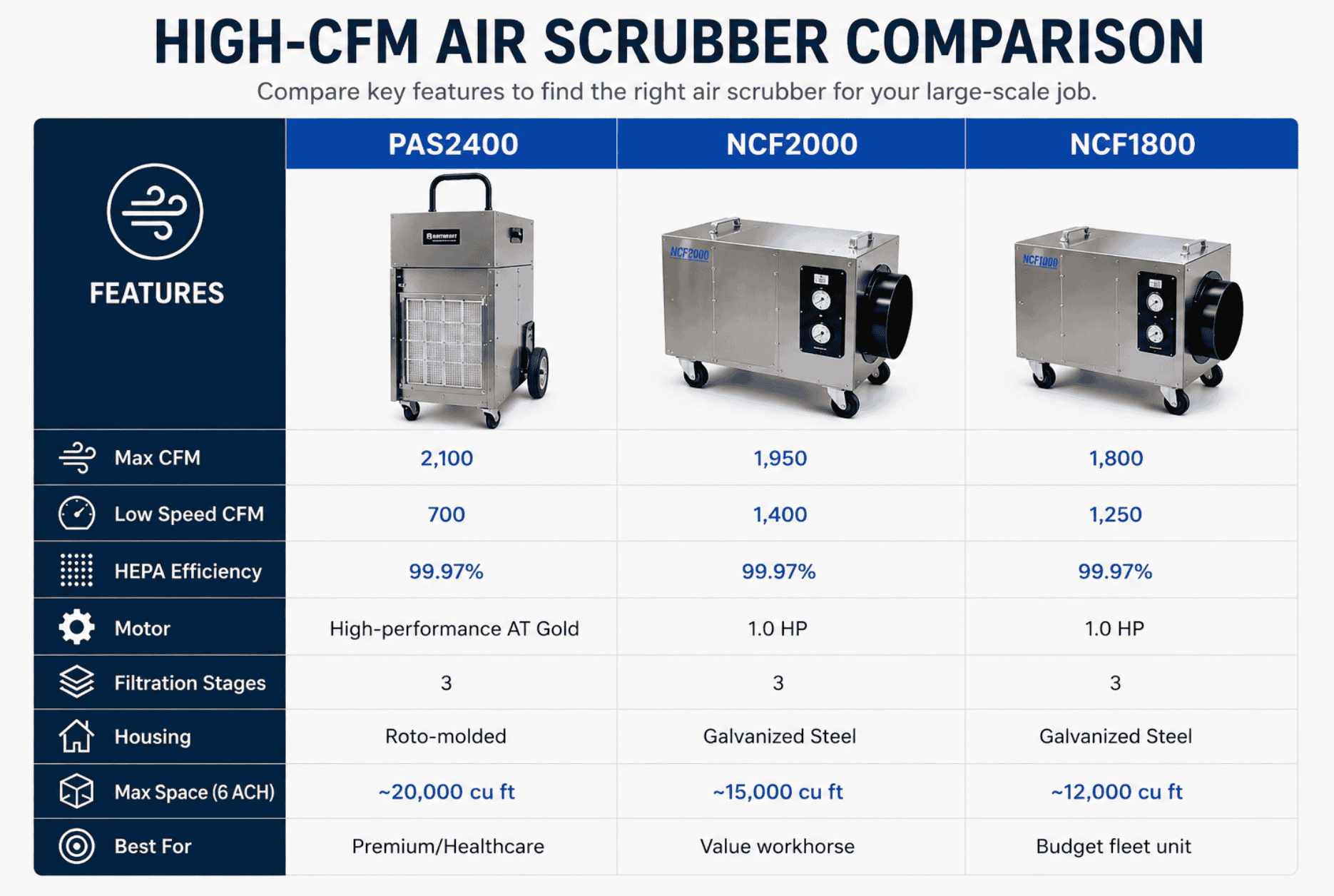
Side-by-Side Comparison
Compliance Notes for Regulated Job Sites
If your work is governed by OSHA, EPA RRP, or ICRA standards, your air scrubber selection must support documented compliance:
- OSHA (29 CFR 1926.1101) for asbestos abatement requires negative pressure enclosures with HEPA-filtered exhaust. All three machines above meet this requirement.
- EPA RRP Rule for lead work in pre-1978 buildings requires HEPA vacuum and containment. The NCF series and PAS2400 are all HEPA-compliant at rated airflow.
- ICRA Class III and IV healthcare construction standards require demonstrable negative pressure in the work zone. The PAS2400's compact form factor and pressure gauge make it the preferred choice for Class IV work.
- IICRC S520 mold remediation standard recommends a minimum of 4 ACH in the containment area. Any of the three machines above achieves this for their respective space sizes.
Always verify filter certification documentation and keep pressure gauge readings logged during regulated projects.
Shop High-CFM Air Scrubbers at Spycor Environmental
Frequently Asked Questions
What CFM do I need for a large room air scrubber?
For spaces over 5,000 cubic feet (roughly a 600 sq ft room with 8 ft ceilings), you need at least 1,000 CFM to achieve the minimum 4 air changes per hour required for professional remediation. For hazardous environments (mold, asbestos, lead), target 1,500–2,100 CFM to hit the recommended 6 ACH.
Can I use one 2,000 CFM air scrubber for a very large space?
A single 2,100 CFM unit like the PAS2400 can handle up to approximately 20,000 cubic feet at 6 ACH. For larger spaces — think multi-room commercial projects or large warehouses — run two or more units in parallel, placed strategically to create directional airflow through the containment zone.
Is a negative air machine the same as an air scrubber?
They use the same HEPA filtration technology, but operate differently. An air scrubber recirculates cleaned air within the space. A negative air machine exhausts filtered air outside the containment, creating negative pressure (a vacuum) to prevent contaminants from escaping the work zone. For regulated abatement work, negative air mode is typically required.
How long do HEPA filters last in a high-CFM machine?
In a heavily contaminated environment (active mold or asbestos abatement), expect to replace HEPA filters every 200–400 hours of operation. In lighter-duty construction dust control, a HEPA filter can last 600+ hours. Monitor the pressure gauge — when it exceeds the manufacturer's maximum reading (typically 2.6" W.C. on high speed), it's time to replace the filter regardless of hours logged.
Do these air scrubbers qualify for job site use under OSHA regulations?
Yes. All three machines — the PAS2400, NCF2000, and NCF1800 — are equipped with 99.97% HEPA filtration rated at their operating airflow, making them compliant with OSHA's negative pressure enclosure requirements for asbestos abatement and suitable for EPA RRP lead work. Always verify current regulatory requirements with OSHA and your local authority having jurisdiction.