Posted by Spycor Building on Jun 18th 2026
Every contractor has gotten that call. The job was finished a year ago — maybe two. Now the client is reporting cracked stucco, bubbling paint, mold behind the stone veneer, or fiber cement siding that's starting to swell at the edges. The framing was solid. The installation looked right. But the wall is failing.
In most cases, the root cause is the same: moisture that had nowhere to go.
Absorptive claddings like conventional stucco, manufactured stone veneer, and fiber cement act as sponges. They pull in water from rain, absorb vapor driven by the sun, and hold it against the sheathing. A standard water-resistive barrier slows the intrusion — but it doesn't drain it, ventilate it, or give it a path out. Over time, that trapped moisture destroys wall assemblies from the inside.
DELTA®-DRY Ventilated Rainscreen was built to solve this problem. It is the only dual-chambered ventilated rainscreen that actively drains and ventilates the wall on both sides of the membrane simultaneously — giving contractors a reliable, code-compliant solution that protects the wall assembly for the life of the building.
Why These Three Claddings Are High-Risk: The Reservoir Effect
Stucco, manufactured stone veneer, and fiber cement are all classified as reservoir claddings — materials that absorb and temporarily store bulk water. When it rains, they soak it in. When the sun comes out, they release that stored moisture as vapor — driving it inward, directly toward the sheathing, the framing, and eventually the interior.
This inward vapor drive is the leading cause of moisture failures in modern wall assemblies. It bypasses surface-applied WRBs, saturates sheathing, and creates the conditions for mold growth, wood rot, and structural deterioration — often before any visible exterior damage appears.
Without a ventilated drainage plane installed between the cladding and the WRB, there is no mechanism to intercept that moisture, no air movement to support drying, and no path for bulk water to escape.
Moisture Failures Behind Stucco Walls
Stucco is among the highest-risk cladding systems for moisture damage. Three failure modes are responsible for most callbacks:
Bulk water intrusion through cracks. Stucco is rigid and prone to cracking as a building settles. Every crack becomes an entry point for wind-driven rain. Without a drainage cavity behind the stucco, that water has nowhere to go but into the sheathing.
Solar-driven inward vapor migration. A rain-saturated stucco wall exposed to afternoon sun can push significant moisture vapor inward in a matter of hours. Standard housewrap is not designed to manage this load.
Construction moisture trapped at close-in. Framing and sheathing that get wet during the build and are closed in before fully drying remain a chronic moisture source. A ventilated air space that allows drying after installation is the only reliable remedy.
DELTA®-DRY addresses all three. Its dual-chamber HDPE structure creates drainage channels on both the interior and exterior faces of the membrane. Bulk water that enters the assembly flows down and out through the drainage channel. Vapor trapped behind the sheathing escapes through the ventilated air space between the membrane and the sheathing board. Construction moisture has a path to dry even after close-in.
Moisture Failures Behind Manufactured Stone Veneer
Manufactured stone veneer (MSV) is the highest-risk cladding application in residential and light commercial construction today. The IRC addresses this directly — R703.12 requires a code-compliant drainage plane behind adhered MSV in most jurisdictions.
The primary failure mechanism is mortar absorption. The scratch coat applied during MSV installation is highly porous. It absorbs water, holds it at the sheathing face, and provides no capillary break. In high-humidity climates or regions with significant seasonal rainfall, sheathing behind MSV can remain at elevated moisture content year-round.
The secondary failure is mortar clog. In a standard rainscreen mat or simple gap, mortar squeeze-through during installation fills the drainage space, rendering it nonfunctional from day one.
DELTA®-DRY solves both. The semi-rigid HDPE membrane creates a complete capillary break behind the cladding — physically separating the wet scratch coat from the sheathing surface. The structured dimple-and-groove design maintains the drainage cavity even under the weight of the scratch coat. For MSV and conventional stucco applications specifically, the DELTA®-DRY STUCCO & STONE variant adds a factory pre-installed polypropylene mortar screen that prevents scratch coat from entering and clogging the drainage channels.
Moisture Failures Behind Fiber Cement Siding
Fiber cement is less porous than stucco or manufactured stone, but it is not waterproof. Moisture enters at cut edges, fastener penetrations, and unsealed joints. The failure modes are different but equally costly:
Paint adhesion failure. When moisture cycles through fiber cement — absorbing during rain, releasing during dry periods — it breaks the bond between the surface coating and the substrate. Repainting a large installation every three to four years is a real and avoidable cost.
Edge swelling at cuts. Field-cut edges that are not primed and sealed are the most vulnerable point in a fiber cement installation. Swelling at these edges causes joint separation and cladding distortion over time.
Manufacturer warranty requirements. James Hardie and most fiber cement manufacturers specify a minimum ventilated air gap behind the siding as a warranty condition. Installing directly over housewrap without a drainage plane can void coverage.
DELTA®-DRY creates the ventilated air space fiber cement needs to perform to spec. The drainage channel manages incidental moisture at the sheathing interface. The ventilated cavity supports the drying cycle that keeps fiber cement paint intact and edges stable. And it satisfies the air gap requirement that major fiber cement manufacturers specify for warranty compliance.
What DELTA®-DRY Does That a WRB Alone Cannot
A water-resistive barrier is a moisture barrier. DELTA®-DRY is a moisture management system. The difference matters.
A WRB resists the passage of bulk water — but it does not drain, ventilate, or create a capillary break. When moisture gets past it, whether through cracks, joints, or vapor drive, it has nowhere to go.
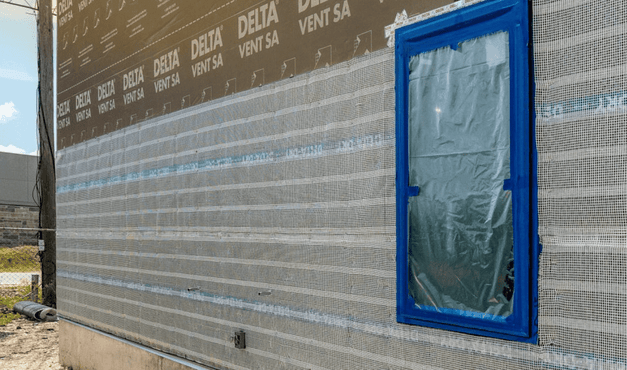
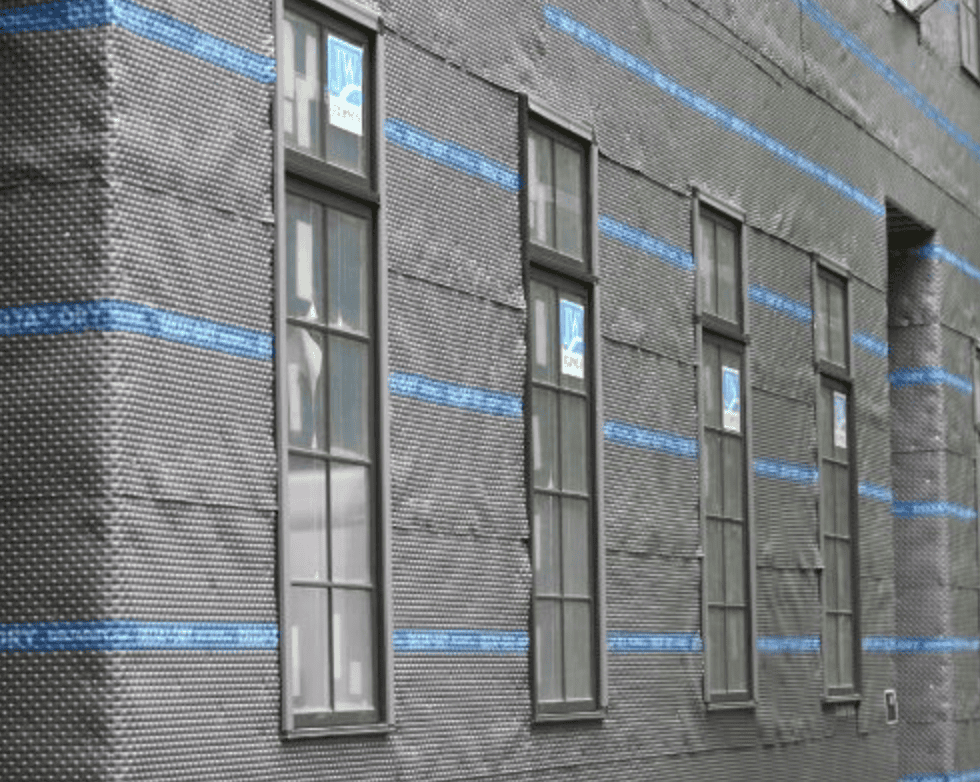
DELTA®-DRY is a semi-rigid, high-density polyethylene membrane with a unique three-dimensional dimple-and-groove structure. That structure creates two independent drainage and ventilation channels: one on the exterior face (between the membrane and the cladding) and one on the interior face (between the membrane and the sheathing board).
The key technical properties:
- Material: High-Density Polyethylene (HDPE) — waterproof, durable, resistant to mold, UV-stable
- Profile: 10.5 mm — provides the air gap required by major cladding manufacturers and IRC drainage provisions
- Dual-chamber design: simultaneous drainage and ventilation on both faces of the membrane
- Complete capillary break: physically separates the cladding from the WRB and sheathing, eliminating moisture wicking
- Installation: installed outboard of the WRB over sheathing board; can also substitute for a conventional WRB where building authorities permit
- Cutting and seaming: cuts easily with a utility knife; seams are butted, not overlapped — no special tools or tape required
- Approval: ICC Evaluation Report ER-0908
DELTA®-DRY is manufactured by Dörken Systems Inc., the North American subsidiary of Ewald Dörken AG — a company with over 125 years of experience in building envelope protection.
Which DELTA®-DRY Format Is Right for Your Project?
DELTA®-DRY Ventilated Rainscreen is available in two configurations at Spycor Building Products:
| Format | Coverage | Best For | Order |
|---|---|---|---|
| Single Roll — 3.3' × 50' | 162.5 sq. ft. | Residential projects, additions, trial orders | View Single Roll → |
| Skid of 24 Rolls — 3.3' × 50' each | 3,900 sq. ft. | Commercial projects, multi-unit residential, large custom homes | View Skid of 24 → |
Quick estimate guide: Measure your total wall surface area in square feet. Subtract window and door openings. Add 10% for overlaps, cuts, and waste. If your net coverage requirement exceeds 500 sq. ft., the skid of 24 rolls at 3,900 sq. ft. offers better per-roll pricing and eliminates reorder delays on active job sites.
For stucco and manufactured stone applications, pair with DELTA®-DRY STUCCO & STONE for the integrated mortar screen, or DELTA®-DRY & LATH for the one-step rainscreen-plus-lath system.
The Bottom Line for Contractors and Builders
The cost of one moisture callback — mobilization, remediation, reframing, recladding, and the reputational damage — exceeds the cost of protecting every linear foot of wall on that job with DELTA®-DRY.
The dual-chamber HDPE membrane drains what gets in, ventilates what gets trapped, and breaks the capillary connection between the cladding and the sheathing. It installs fast, cuts clean, and carries an ICC Evaluation Report. For stucco, manufactured stone, and fiber cement assemblies, it is the most technically complete ventilated rainscreen available from a distributor that stocks both residential and commercial formats.
Ready to spec it for your next project?
- DELTA®-DRY Single Roll — 162.5 sq. ft. — residential jobs and smaller builds
- DELTA®-DRY Skid of 24 Rolls — 3,900 sq. ft. — commercial and large residential projects
Frequently Asked Questions
What is DELTA®-DRY Ventilated Rainscreen used for?
DELTA®-DRY is a ventilated rainscreen membrane installed between a wall's water-resistive barrier and its exterior cladding. It creates a drainage and ventilation cavity that manages bulk water intrusion, inward vapor drive, and construction moisture — protecting the structural wall assembly from long-term moisture damage.
What claddings require a ventilated rainscreen?
Absorptive reservoir claddings carry the highest risk: conventional stucco, adhered manufactured stone veneer, brick veneer, and fiber cement siding. The IRC R703.12 specifically requires a drainage plane behind adhered manufactured stone veneer. Most major fiber cement manufacturers also specify a minimum air gap as a warranty condition.
Does DELTA®-DRY replace a water-resistive barrier (WRB)?
DELTA®-DRY is installed outboard of — not in place of — a code-appropriate WRB in standard applications. However, Dörken notes it can be installed in lieu of a conventional WRB in jurisdictions where building authorities permit this application. Confirm local code requirements before substituting.
How is DELTA®-DRY installed?
The membrane installs outboard of the WRB over the sheathing board. It cuts with a standard utility knife and requires no special tools. Seams are butted rather than overlapped, which reduces material use and simplifies alignment. Exterior cladding installs directly over the membrane as usual.
What is the difference between DELTA®-DRY and DELTA®-DRY STUCCO & STONE?
Standard DELTA®-DRY is the general-purpose ventilated rainscreen for siding and other cladding applications. DELTA®-DRY STUCCO & STONE adds a factory pre-installed polypropylene mortar screen that prevents scratch coat mortar from entering and clogging the drainage cavity — making it the more purpose-built choice for adhered MSV and conventional stucco.
What is the difference between a single roll and a skid order?
A single roll covers 162.5 sq. ft. and is best for residential additions, smaller projects, or first-time orders. A skid of 24 rolls covers 3,900 sq. ft. and is the right format for larger residential builds, commercial projects, and multi-unit jobs where reorder delays would affect the schedule.
Where can I buy DELTA®-DRY Ventilated Rainscreen?
DELTA®-DRY is available at Spycor Building Products in both single-roll and skid-of-24 configurations, with fast shipping and competitive pricing. Order the single roll here or order the skid of 24 rolls here.
Does DELTA®-DRY prevent mold?
DELTA®-DRY does not contain a mold-inhibiting chemical treatment. It prevents mold by eliminating the conditions that cause it — persistent moisture at the sheathing interface. By draining bulk water, ventilating trapped vapor, and creating a capillary break, it keeps the sheathing dry, which is the most reliable long-term mold prevention strategy available.