Posted by Spycor Building on Jul 2nd 2026
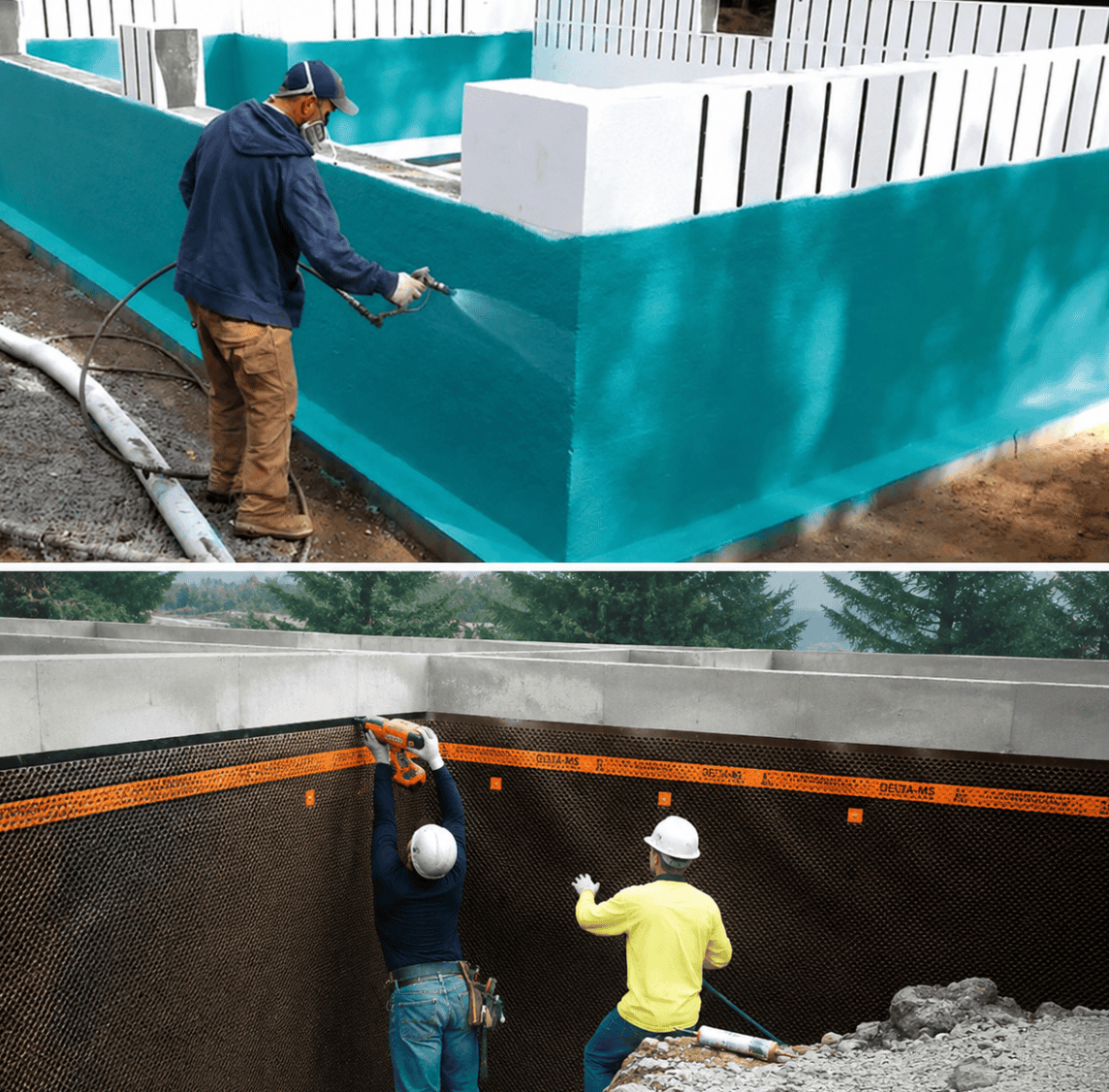
Dimple membranes (an HDPE drainage membrane like DELTA-MS or Platon) create a drainage plane and capillary break that actively relieves hydrostatic pressure against the foundation wall. Fluid-applied waterproofing forms a continuous bonded barrier sealed directly to the wall, with no built-in drainage path of its own. For most residential and commercial foundations, contractors specify a dimple membrane for exterior foundation waterproofing — it's code-approved as a stand-alone system, costs less, and installs faster. On high water table or high-risk sites, contractors often combine both: a fluid-applied membrane for the bonded seal, plus a dimple membrane over it for drainage and puncture protection.
Every foundation waterproofing system has to solve the same problem: keep hydrostatic pressure and groundwater out of a structure that sits below grade. How you solve it depends on soil conditions, water table, drainage design, and budget — not on which product a supplier pushes hardest. This guide breaks down the two dominant approaches to below-grade waterproofing — HDPE drainage membrane and fluid-applied waterproofing — so you can match the foundation waterproofing membrane to the site, not the other way around.
At a Glance: Dimple Membrane vs. Fluid-Applied Waterproofing
| Factor | Dimple Membrane (DELTA-MS / Platon) | Fluid-Applied Waterproofing |
|---|---|---|
| Mechanism | Air-gap drainage plane + capillary break | Continuous bonded seal |
| Hydrostatic pressure handling | Actively drains water away | Relies on seal integrity alone |
| Install conditions | Wide range; no cure time before backfill | Requires temp/cure window before backfill |
| Puncture/backfill risk | HDPE resists tear and puncture damage | Vulnerable to damage from sharp backfill |
| Code status (DELTA-MS) | Approved as stand-alone wall waterproofing material (U.S.) | Varies by product and jurisdiction |
| Typical use case | New construction, retrofits, high water table sites | Sites where a fully bonded seal is specified |
| Can be combined? | Yes — used over spray-applied systems for "belt and suspenders" protection | Yes — often paired with a drainage membrane on demanding sites |
What's the Difference Between Dimple Membrane and Fluid-Applied Waterproofing?
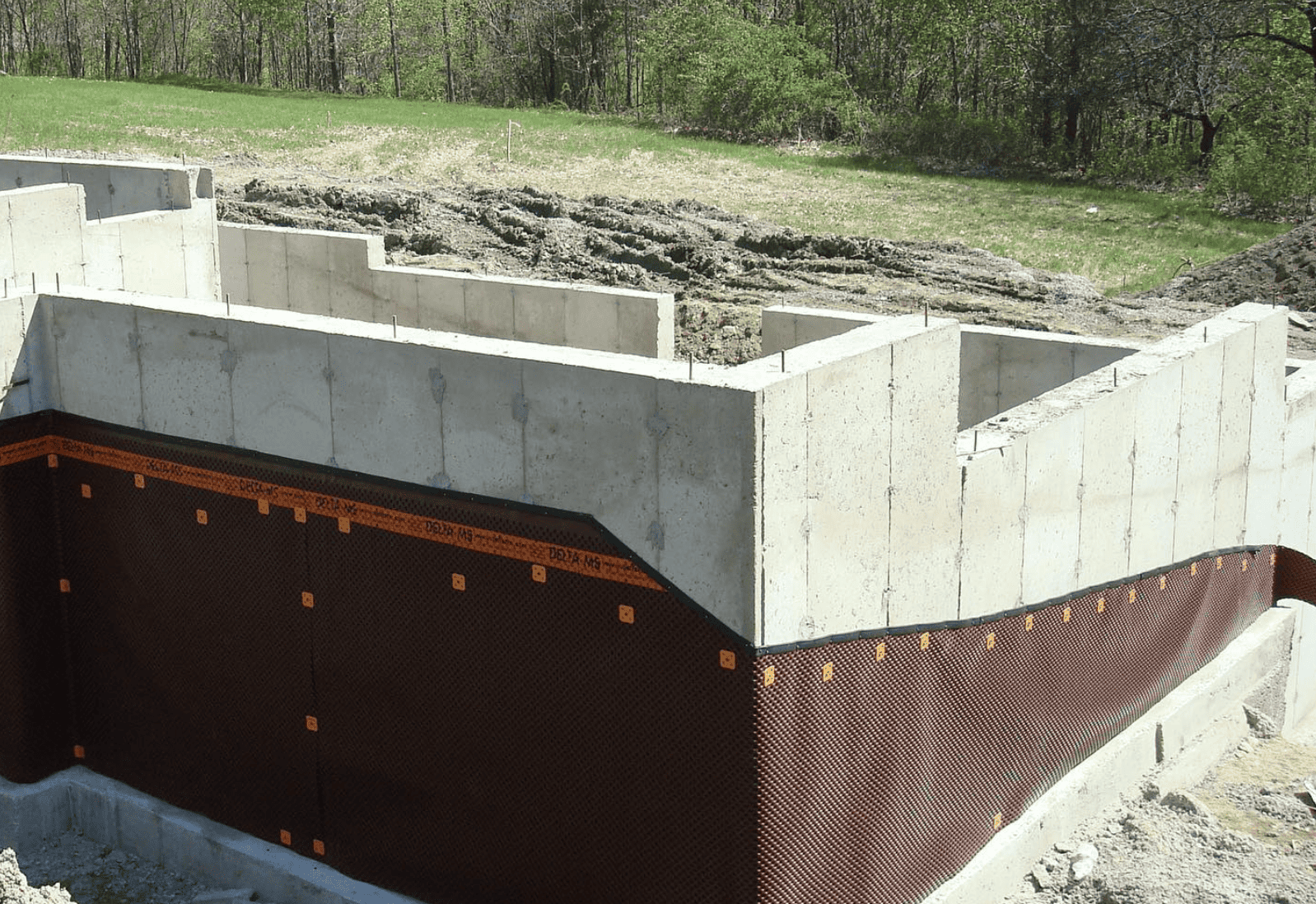
Dimple membrane — also called a foundation drainage board or HDPE drainage membrane — is a high-density polyethylene sheet with a raised, dimpled surface that creates a physical air gap between the foundation wall and the surrounding soil. Products like DELTA-MS and Platon Foundation Wrap work this way: the air gap acts as a capillary break, so water never contacts the wall directly. Instead, it drains down to the footing drain. This is the core method behind most modern exterior foundation waterproofing: manage the water at the wall face instead of just trying to seal it out entirely. DELTA-MS is code-approved for use as a stand-alone wall waterproofing material in the U.S., meaning it doesn't require a spray or tar coating underneath it to perform.
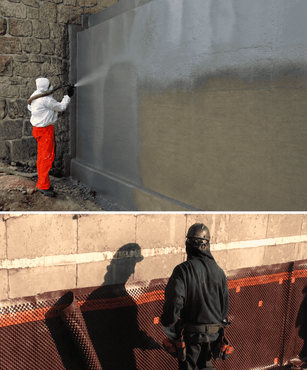
Fluid-applied waterproofing is a liquid or spray-applied coating (asphalt-modified, rubberized, or polymer-based) that cures into a continuous membrane bonded directly to the foundation wall. It seals the surface rather than creating a drainage plane, and its performance depends heavily on proper surface prep, cure time, and avoiding punctures during backfill.
How Contractors Decide Between the Two
The decision isn't about which product is "better" — it's about matching the below-grade waterproofing approach to site conditions. Whether you're specifying a basement waterproofing system for a residential build or a full commercial foundation package, three factors drive the call on most jobs:
1. Soil and water table. High water tables, clay soils, or sites at the base of a slope create sustained hydrostatic pressure. A drainage membrane actively relieves that pressure by giving water somewhere to go. A fluid-applied coating alone has no drainage path — it relies purely on the seal holding under pressure.
2. Whether the space will be finished. If the below-grade space will be finished living area (not just utility storage), the cost of a callback from moisture intrusion is much higher than the incremental cost of the more robust system. Many contractors default to a drainage membrane, or combine both approaches, whenever the space will be occupied.
3. Installation conditions and schedule. Fluid-applied systems need specific temperature ranges and cure times before backfill — a scheduling risk on tight timelines or in cold-weather markets. Dimple membrane can be installed in a wider range of conditions and doesn't require cure time before backfilling, which is one reason products like Platon are commonly specified on schedule-sensitive residential and commercial jobs.
Best System by Site Condition
| Situation | Recommended System |
|---|---|
| Clay soils, minimal water table | Dimple membrane |
| High water table / sustained hydrostatic pressure | Dimple membrane + fluid-applied (combined) |
| Finished basement or occupied below-grade space | Combined system |
| Budget-conscious new residential build | Dimple membrane |
| Engineer's spec calls for a fully bonded membrane | Fluid-applied |
| Commercial foundation, tight schedule | Dimple membrane (no cure time before backfill) |
| Large commercial foundation, high risk tolerance for callbacks | Combined system |
Do You Need Both?
On many commercial and high-risk residential jobs, the answer is yes. Fluid-applied waterproofing provides the bonded seal against the wall, while a dimple membrane like DELTA-MS or Platon installed over it adds a mechanical drainage plane and protects the coating from puncture during backfill. This combined approach is common where designers specify "belt and suspenders" protection — it's not redundant, it's two different failure modes covered at once.
Where DELTA-MS and Platon Fit
Both DELTA-MS and Platon are HDPE dimpled membranes designed to be installed as a stand-alone foundation protection system or layered over an existing fluid-applied or spray coating as a secondary drainage plane and puncture shield. Neither is a substitute for a fluid-applied membrane if your spec calls specifically for a fully bonded seal — but for the large majority of foundation walls, especially where hydrostatic pressure and finished space are factors, a drainage membrane alone meets code and performs at roughly half the cost of a conventional fluid-applied system.
Frequently Asked Questions
Can dimple membrane replace fluid-applied waterproofing?
In most residential and many commercial applications, yes — DELTA-MS is code-approved for use as a stand-alone wall waterproofing material without a spray or tar coating underneath. Site-specific soil and hydrostatic conditions should still guide the final decision.
When does a project require fluid-applied waterproofing instead of a membrane?
When the specifying engineer requires a fully bonded seal against the wall, typically on projects with unusual structural movement risk or where local code explicitly calls for it. Site conditions and the designer's spec take precedence over general guidance.
Do I need both a drainage membrane and a fluid-applied waterproofing membrane?
On high-risk or high-value below-grade spaces, many contractors specify both — the fluid-applied coating provides the bonded seal, and the dimple membrane adds drainage capacity and puncture protection during backfill.
Is dimple membrane more expensive than fluid-applied waterproofing?
Generally no. Dimple membrane systems like DELTA-MS typically run up to half the cost of conventional fluid-applied waterproofing systems while meeting the same code requirements for wall waterproofing.