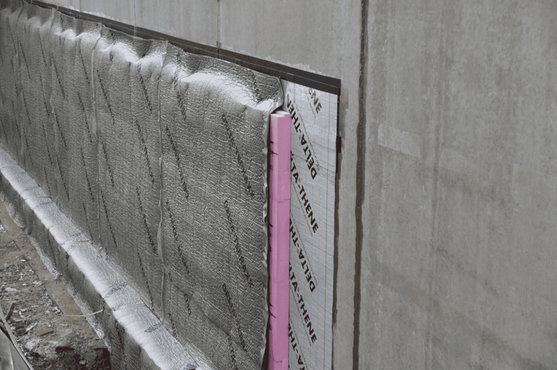
Posted by Spycor Building on Jun 5th 2026
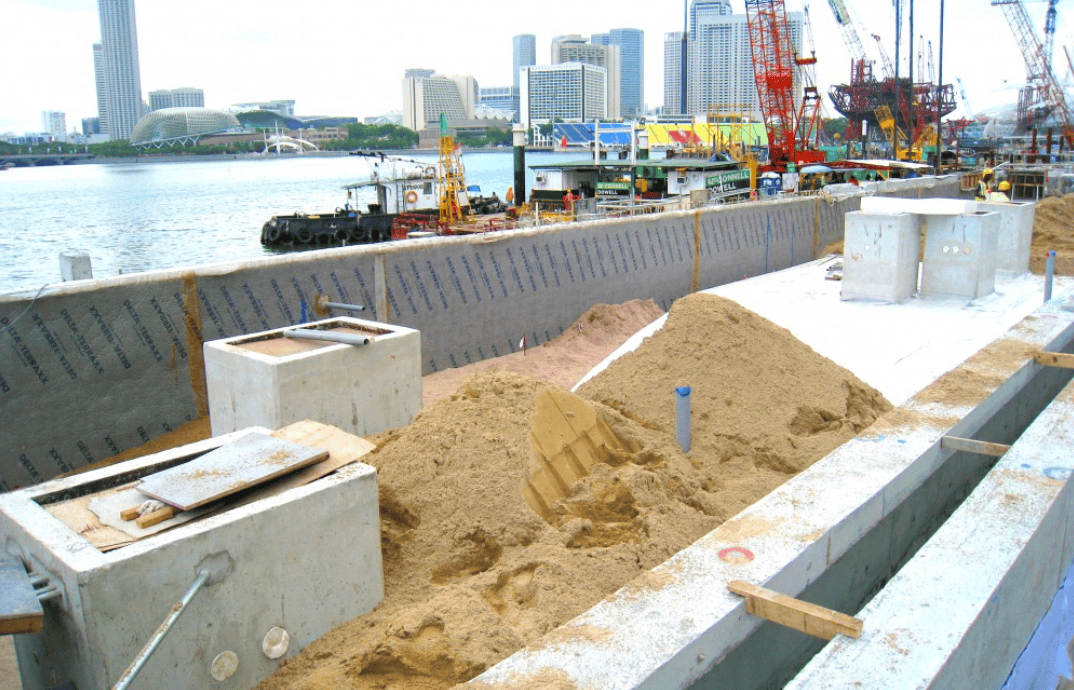
The right drainage board fails when installed wrong. This guide covers every critical detail — fastener patterns, lap sequences, substrate prep, and blind-side technique — so your DELTA-TERRAXX installation performs for its full 100-year rated service life.
Why Proper DELTA-TERRAXX Installation Determines Everything
DELTA-TERRAXX is one of the most specified vertical drainage boards in commercial construction — rated for applications up to seven stories below grade, with a compressive strength of 8,900 psf and a tested service life of 100 years. But those specs are only realized when the product is installed correctly.
The most common failure mode isn't product defect — it's installation error. Incorrectly oriented membranes, interlocked dimples at laps, under-fastened sheets, and improper lap sequences all create pathways for hydrostatic pressure to build or soil particulate to clog the drainage core. This guide eliminates those failure points.
Whether you're waterproofing a commercial below-grade parking structure, a luxury residential foundation, or a podium deck, the installation sequence for DELTA-TERRAXX is precise — and it matters.
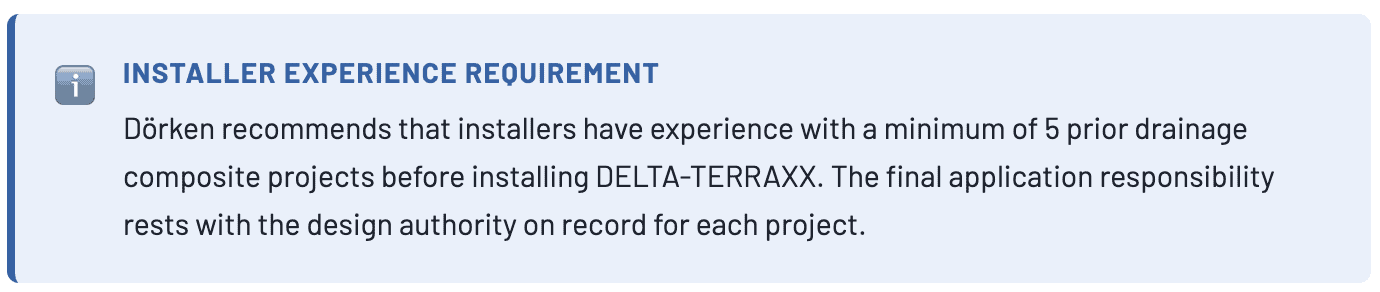
DELTA-TERRAXX 6'7" × 41' Vertical: Specs at a Glance
Before picking up a utility knife, know what you're working with. Understanding the product's physical properties directly informs correct installation decisions.
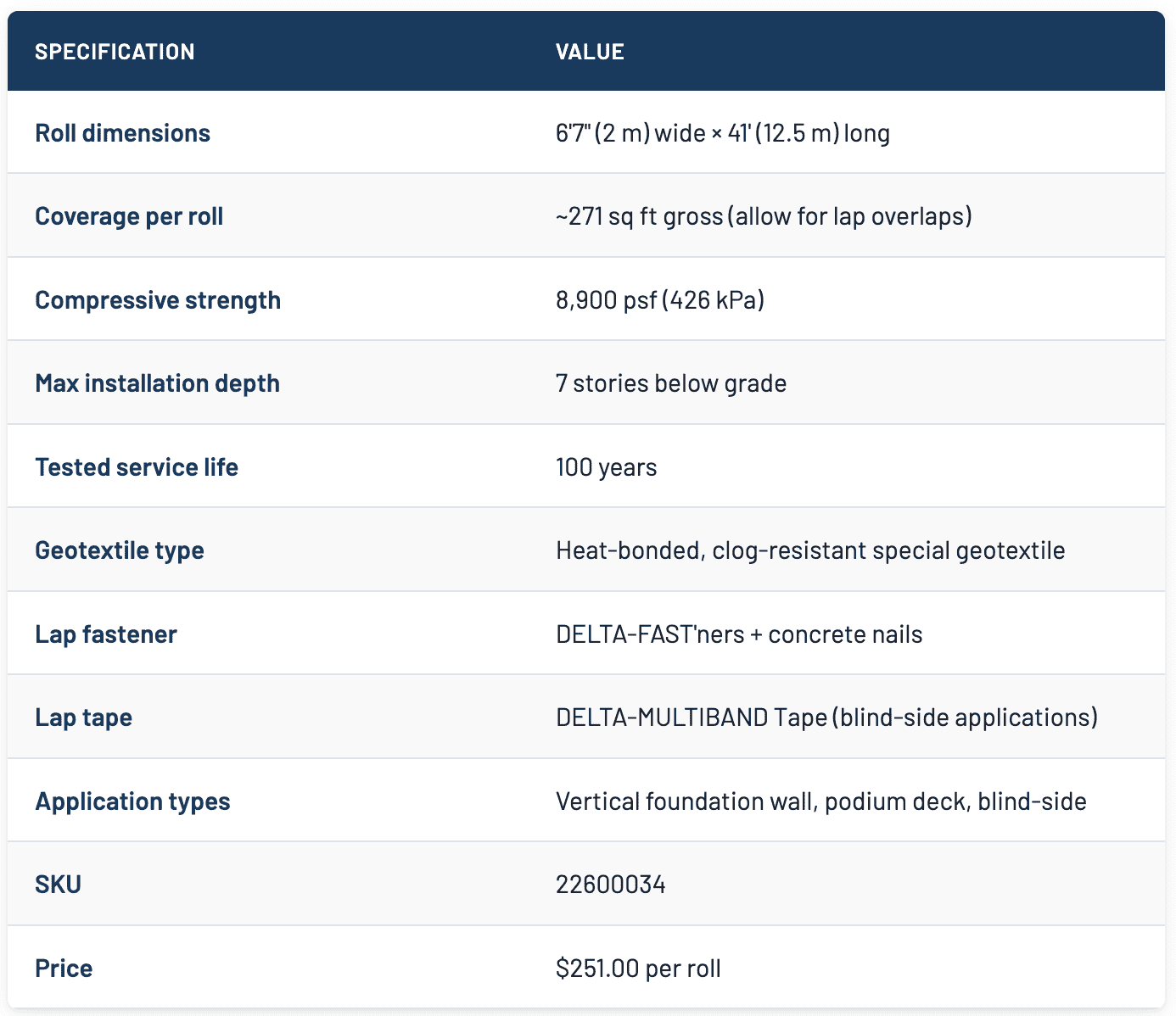
Required Materials, Tools & Safety Equipment
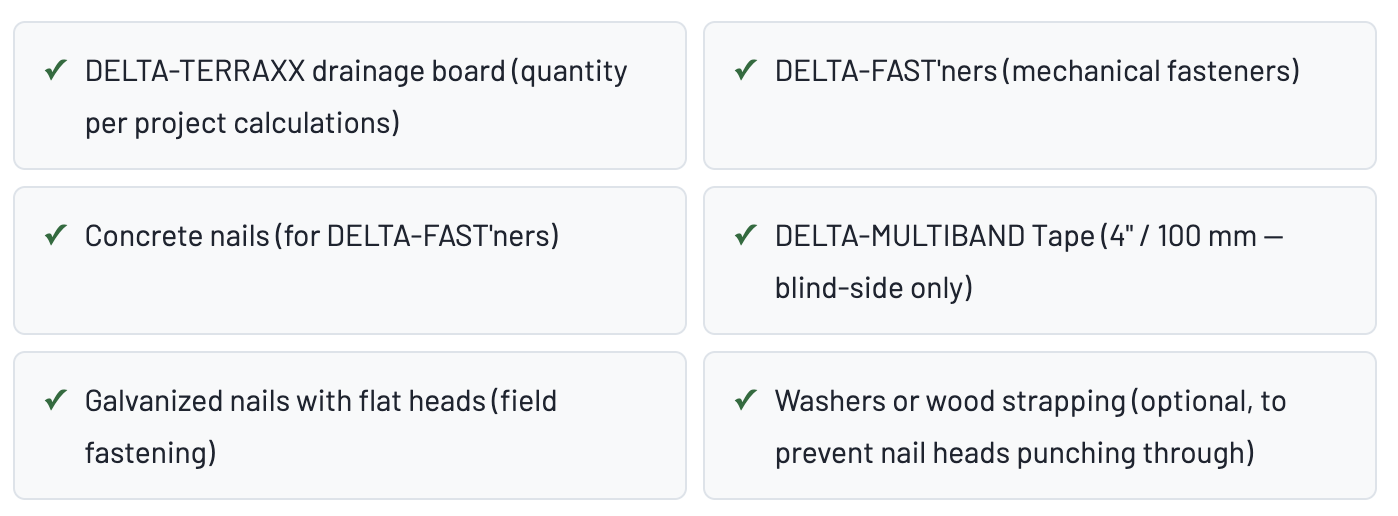
Gather everything before you start. Running out of DELTA-FAST'ners mid-installation forces improvised fastening that creates membrane gaps and warranty voids.
Materials checklist
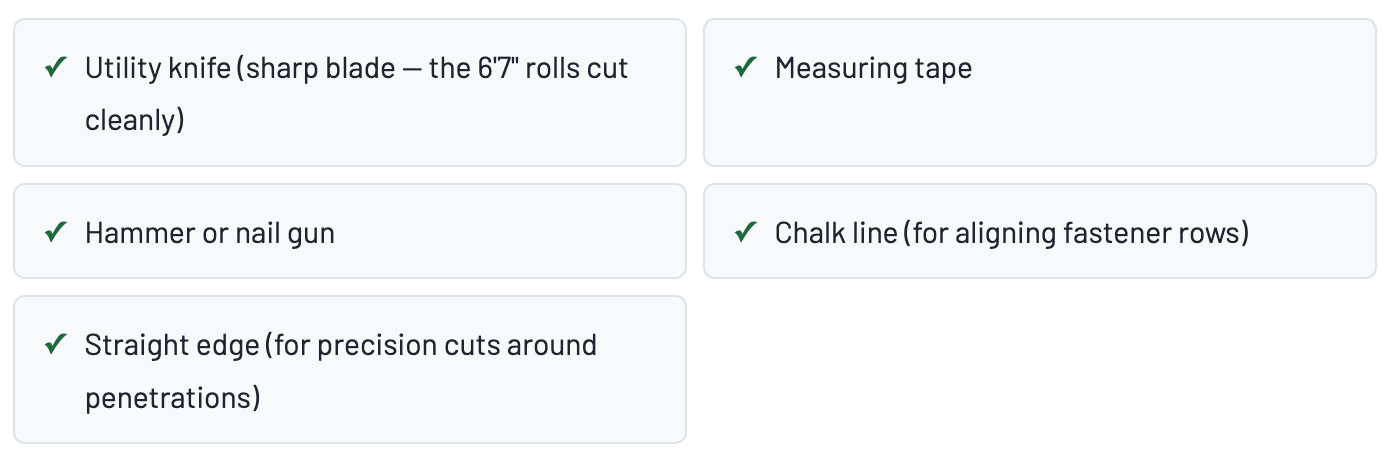
Tools checklist
Required personal protective equipment (PPE)

Foundation Wall Installation: Step-by-Step (Positive Side / Vertical)
This is the primary application for the DELTA-TERRAXX 6'7" × 41' Vertical roll. These steps apply to positive-side foundation wall drainage in commercial and residential below-grade construction.
1. Prepare the substrate
Before unrolling any material, inspect the entire substrate surface. Remove all protrusions — wire ties, concrete fins, form ties, or mechanical anchors — that could puncture the membrane from behind. A compromised membrane under backfill pressure is nearly impossible to repair.
Confirm the waterproofing membrane beneath is fully cured and approved for drainage board application. DELTA-TERRAXX installs over waterproofing, not as a standalone waterproofing system.
2. Orient the membrane correctly
This is the single most common installation error. The flat side goes against the wall. The geotextile (fabric) faces outward toward the soil. The dimpled core creates the drainage air gap between the wall surface and the backfill material.
Start installation at the anticipated grade level and work downward to the footing, as indicated on the construction plans. Do not start from the footing up — the shingle lapping sequence depends on this top-down direction.
Memory cue for orientation"Flat to the wall, fabric to the field." The geotextile side always faces the direction water and soil are coming from.
3. Fasten the first sheet with DELTA-FAST'ners
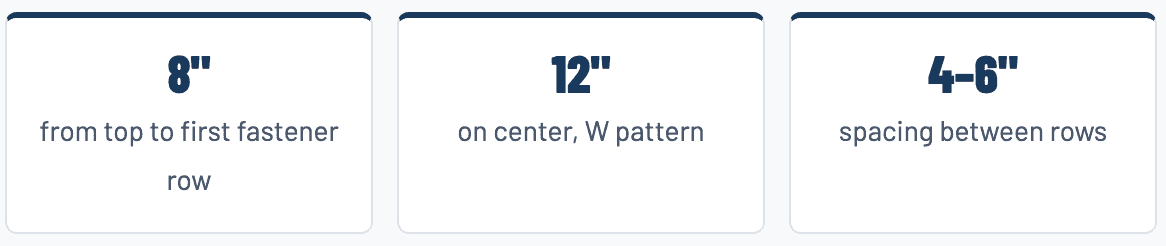
Position the first row of DELTA-FAST'ners 8 inches (200 mm) below the top edge of the DELTA-TERRAXX sheet. This anchors the membrane at the top before the weight of the roll pulls it down.
Fasten in a "W" pattern, 12 inches (305 mm) on center. The W pattern distributes load and prevents the membrane from billowing away from the wall under backfill pressure.
Maintain a row spacing of 4 to 6 inches (100–150 mm) between fastener rows. Use concrete nails with the DELTA-FAST'ners to anchor into the foundation wall.
4.Handle vertical end laps (sheet-to-sheet horizontal)
Where one sheet ends and the next begins horizontally, use a 6-inch (150 mm) downward shingle overlap. The upper sheet overlaps the lower sheet — exactly like roof shingles — so water sheds downward past the lap rather than behind it.
Critical: Do not interlock the dimples at the overlap. Interlocked dimples reduce the drainage channel depth at the lap and can trap soil particulate. Butt the sheets flat at the overlap zone.
Never interlock the dimples
This applies at every lap type — vertical end laps, horizontal end laps, and podium deck side laps. Interlocked dimples compromise drainage capacity and are one of the most frequently cited installation errors.
5. Handle side laps (sheet-to-sheet vertical, using self-adhering flat tab)
DELTA-TERRAXX comes with a self-adhering flat tab along one edge. When placing adjacent vertical sheets side by side, place the next course on top of this flat tab with the dimples butted together.
Remove the release liner from the adhesive strip and press the sheets together, ensuring full, intimate contact between the drainboard edge and the adhesive strip. No additional tape is required at these joints.
Overlap the excess fabric onto the adjoining sheet. This fabric overlap is critical — it prevents soil particulate from entering the drainage air gap at the seam, which is the primary cause of geotextile clogging over time.
6. Finish the top edge and verify the field
Fold the fabric over the top edge and fasten 8 inches on center. This seals the top of the drainage channel against soil particulate entry during backfilling — a detail that's easy to rush and costly to regret.
Before backfilling, do a full visual inspection of the installed membrane: no gaps, no wrinkles, no creases, no tears. Pay particular attention to corners, penetrations, and the footing transition. Any gap is a potential failure point under 8,900+ psf of backfill pressure.
Pre-backfill checklistFlat side to wall throughout ✓ | No interlocked dimples ✓ | 6" end lap shingle fashion ✓ | Side lap adhesive fully bonded ✓ | Top edge folded and fastened ✓ | No gaps, wrinkles, or tears ✓
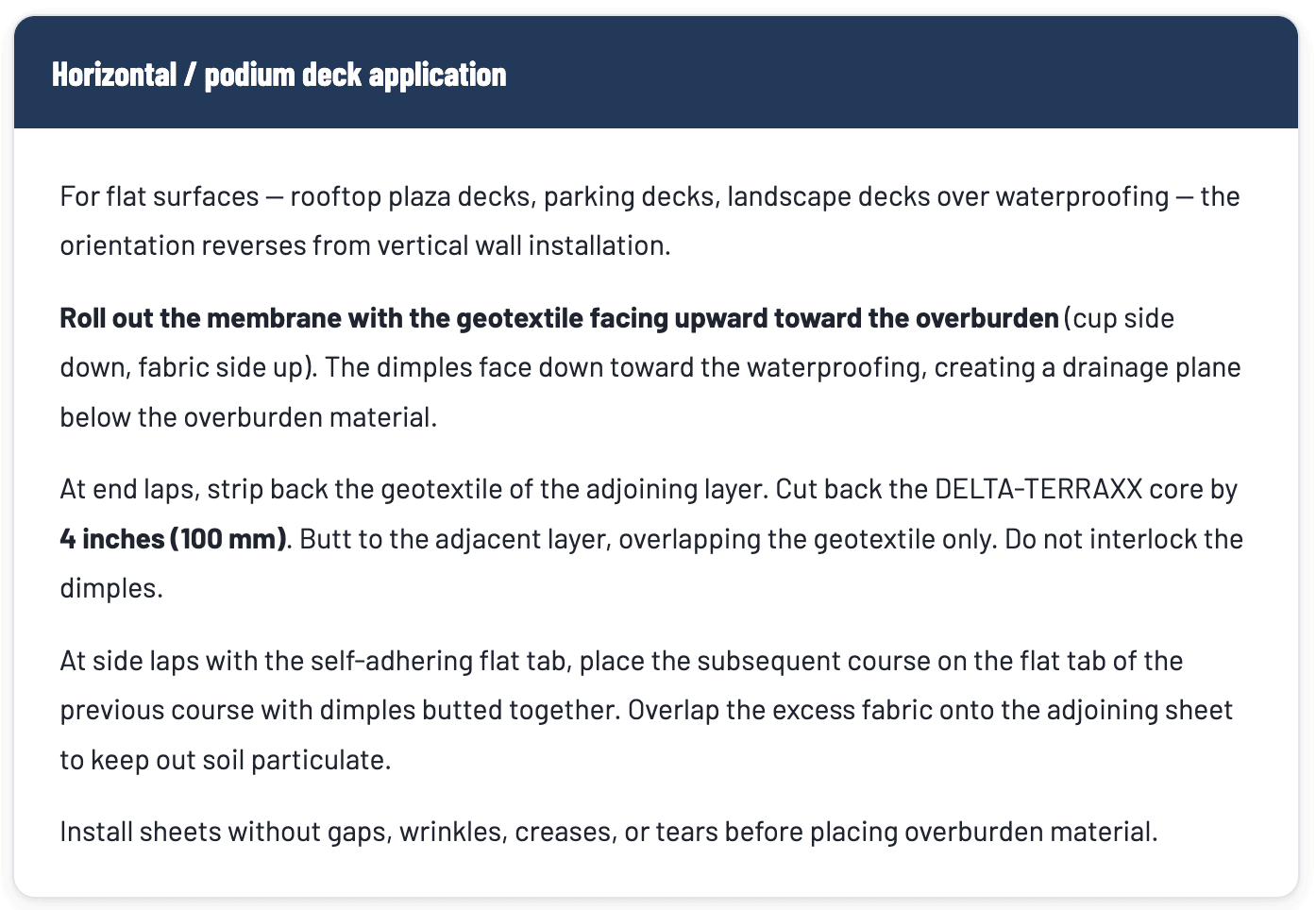
Podium Deck Installation (Flat Surfaces & Roofs)
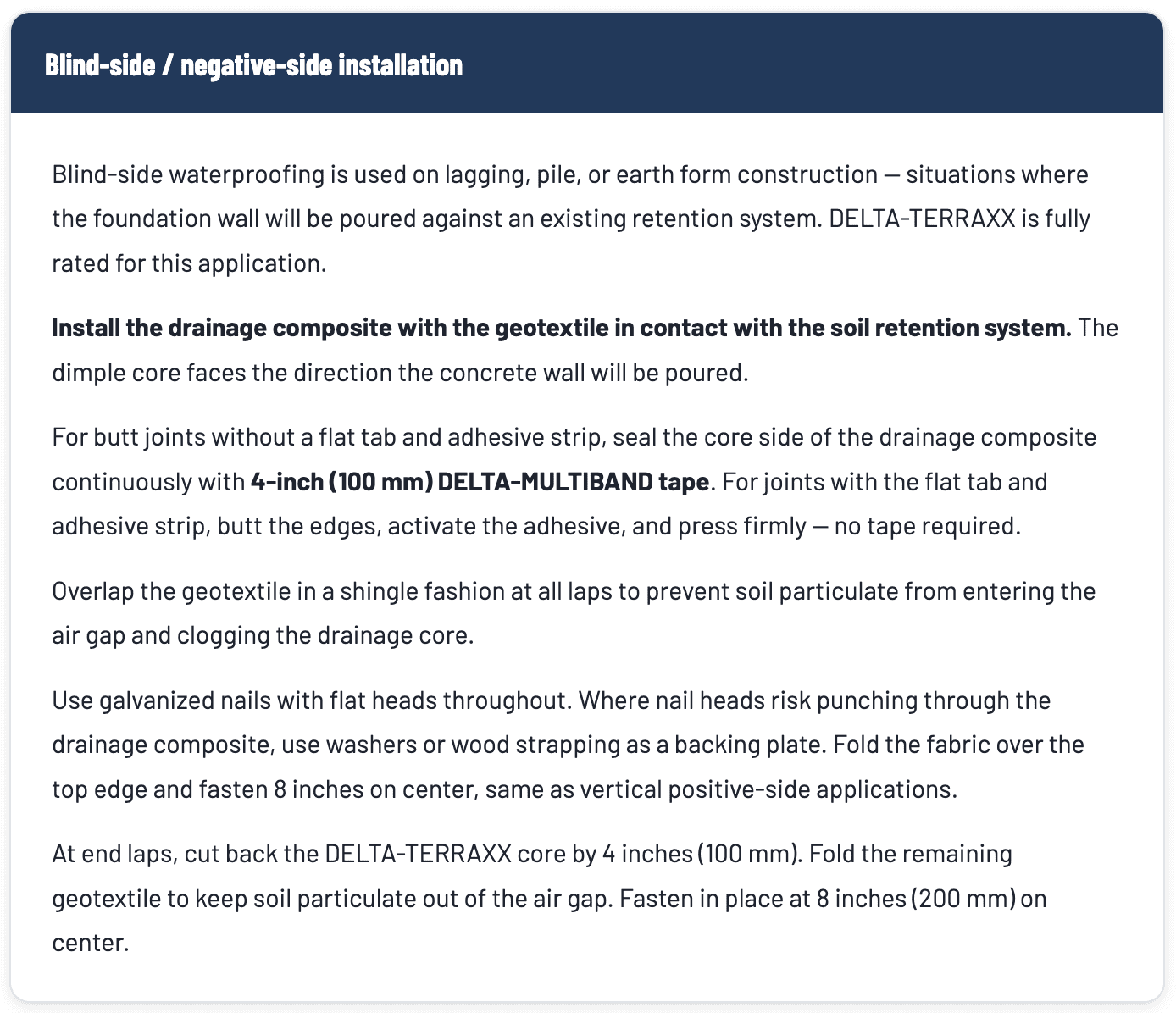
Blind-Side Application (Negative Side)
Why Spec DELTA-TERRAXX Over Commodity Drainage Boards
This installation guide is worth nothing if you're installing the wrong product. Here's what separates DELTA-TERRAXX from commodity dimple boards that look identical on a bid sheet but fail within years.
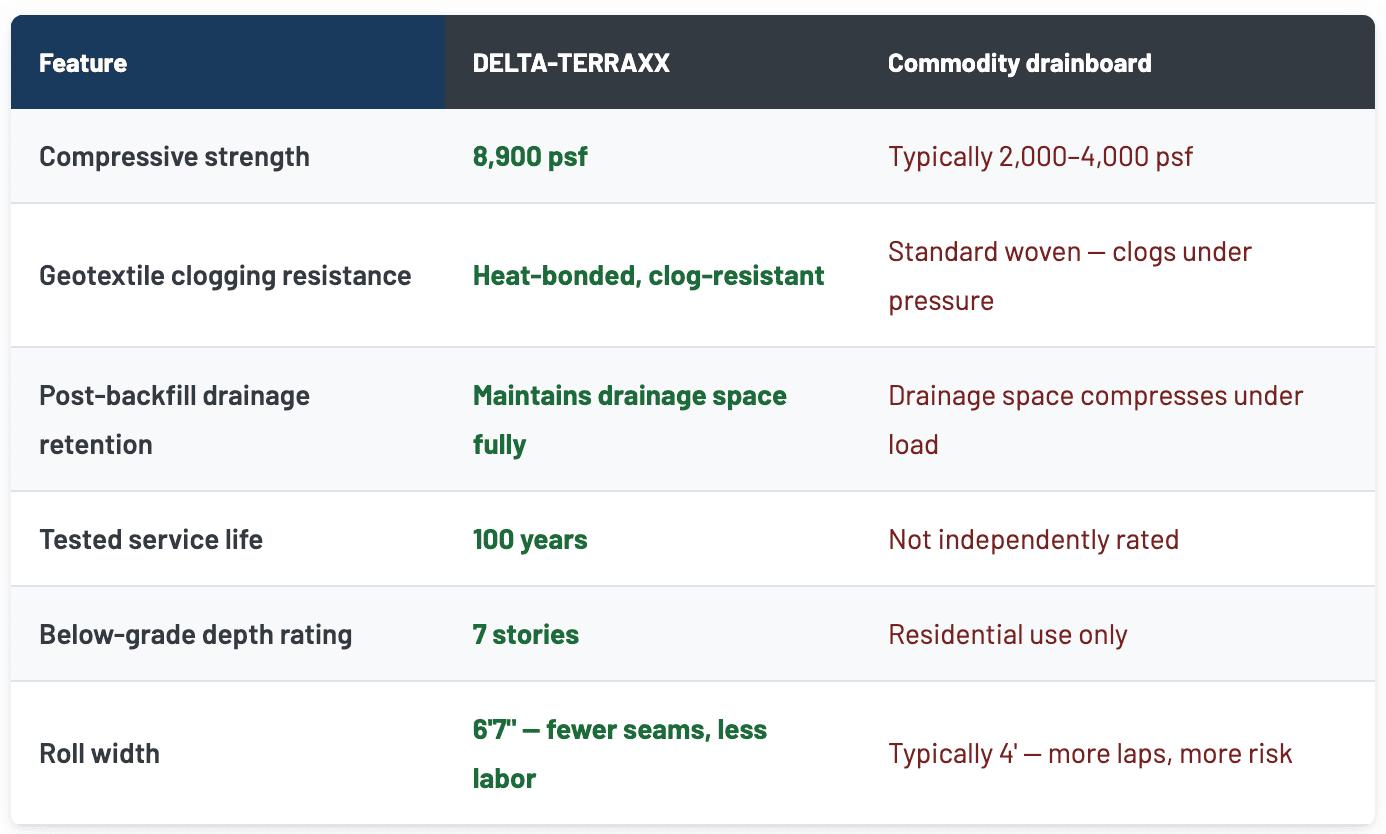
The 6'7" roll width of DELTA-TERRAXX is a significant labor and risk-reduction advantage that's often overlooked. Wider rolls mean fewer laps — and every lap is a potential failure point. On a 10-foot deep foundation wall, a standard 4-foot board requires 2–3 overlapping runs. DELTA-TERRAXX covers the same height in a single pass, cutting installation time and seam count simultaneously.
If you're speccing or purchasing DELTA-TERRAXX for a US project, Spycor Building Products carries the 6'7" × 41' Vertical roll in stock — ready to ship with no lead-time uncertainty.
Spycor is a specialized building products supplier serving commercial contractors, waterproofing subs, and homebuilders across the US. Unlike big-box distributors, Spycor stocks the full Dörken DELTA product line and has technical staff who understand drainage composite applications, not just SKU numbers.
Order DELTA-TERRAXX at spycorbuilding.com — or call (843) 517-8180 for quantity pricing and project support.
Frequently Asked Questions: DELTA-TERRAXX Installation
- Which way does DELTA®-TERRAXX face on a foundation wall?
Install DELTA-TERRAXX with the flat side against the wall and the geotextile (fabric) facing outward toward the soil. The dimples create the drainage air gap between the wall surface and the backfill material.
- How much do you overlap DELTA®-TERRAXX at vertical end laps?
When installed vertically, overlap end laps by 6 inches (150 mm) in a downward shingle fashion. The upper sheet always overlaps the lower. Never interlock the dimples at the overlap. - What fastener pattern does DELTA®-TERRAXX require?
Use DELTA-FAST'ners with concrete nails in a W pattern, 12 inches (305 mm) on center. Position the first fastener row 8 inches (200 mm) below the top of the sheet. Maintain 4–6 inches of spacing between fastener rows. - Can DELTA®-TERRAXX be used on blind-side applications?
Yes. For blind-side (negative-side) applications on lagging, pile, or earth forms, install with the geotextile in contact with the soil retention system. Seal butt joints with 4-inch DELTA-MULTIBAND tape on the core side. Joints with the self-adhering flat tab do not require additional tape. - How many square feet does one roll of DELTA®-TERRAXX 6'7" × 41' cover?
One roll covers approximately 271 square feet of foundation wall surface gross (6.7 ft × 41 ft = 274.7 sq ft). Factor in the 6-inch lap overlaps at each seam when calculating total material quantities for your project. - How deep below grade can DELTA®-TERRAXX be installed?
DELTA-TERRAXX is rated for vertical applications up to seven stories below grade, making it suitable for deep commercial excavations, underground parking garages, and high-rise foundation walls — far beyond the capabilities of residential-grade drainboards. - Do I need to tape all the laps on DELTA®-TERRAXX?
For positive-side vertical applications, the self-adhering flat tab handles side laps — no additional tape required. For blind-side applications, seal butt joints on the core side with DELTA-MULTIBAND tape. Joints with the self-adhering flat tab on blind-side installs also do not require tape.