Posted by Spycor LLC on Jun 25th 2026
If you work in healthcare construction, hospital facilities management, or infection control, you have probably asked this question before:
"Do I need a portable HEPA air cleaner or a negative air machine for this job?"
They look similar. They both filter air. But they are not the same — and using the wrong one can put your ICRA compliance at risk, endanger patients, and cost your team time and money.
This guide breaks down the difference clearly, tells you exactly which buyers need which equipment, and helps you choose the right unit for your specific project — including one hospital-grade machine that does both.
What Is a Portable HEPA Air Cleaner?
A portable HEPA air cleaner is a self-contained unit that pulls contaminated air through a HEPA filter and returns clean, filtered air back into the same room.
How it works:
- Unfiltered air enters through the bottom of the unit
- A pre-filter captures large particles like dust and debris
- A HEPA filter captures 99.97% to 99.99% of airborne particles as small as 0.3 microns — including mold spores, bacteria, and fine construction dust
- Cleaned air is discharged back into the room through the top exhaust grille
Primary purpose: Improve air quality and reduce airborne contaminants inside a space.
Typical airflow: 400 to 800 CFM depending on the unit.
Best used for:
- Occupied or semi-occupied healthcare spaces
- Infection control during renovation or maintenance
- ICRA Class I and Class II projects
- Waiting rooms, patient rooms, corridors near active construction
What Is a Negative Air Machine?
A negative air machine (also called a negative pressure unit) is designed to exhaust filtered air out of a contained space — creating negative pressure inside the containment zone so that contaminated air cannot escape into clean areas.
How it works:
- Air is pulled from the contained work area through a HEPA filter
- The filtered, clean air is then exhausted outside the containment — through a window, duct, or exterior wall
- Because more air is leaving than entering, the space becomes negatively pressurized
- Any air leaks in the containment barrier pull inward, preventing dust and pathogens from escaping
Primary purpose: Contain airborne contaminants and protect surrounding clean areas.
Typical airflow: 500 to 2,000+ CFM depending on project size.
Best used for:
- ICRA Class III and Class IV projects
- Abatement work — mold, asbestos, lead
- Demolition inside occupied healthcare facilities
- Any project requiring a sealed containment zone with pressure differential
Key Differences at a Glance
| Portable HEPA Air Cleaner | Negative Air Machine | |
| Air flow direction | Recirculates air back into room | Exhausts air out of containment |
| Creates negative pressure | Sometimes (if configured for exhaust) | Yes — that is its primary function |
| HEPA filtration | Yes — 99.97% to 99.99% | Yes — 99.97% to 99.99% |
| Best for | Occupied spaces, air quality improvement | Sealed containment, ICRA III/IV, abatement |
| Duct required | No (recirculation mode) | Yes (exhaust mode) |
| ICRA Class | I, II, some III | III, IV |
| Typical buyer | Facilities managers, infection control | Abatement and construction contractors |
What ICRA Compliance Actually Requires
ICRA — Infection Control Risk Assessment — is the standard used by hospitals and healthcare facilities to manage the risk of construction-related infection during renovation, repair, and maintenance work.
The ICRA matrix assigns a risk class (I through IV) based on:
- Type of work being done (minor maintenance vs. major demolition)
- Patient population at risk (low risk vs. immunocompromised)
Each class requires specific infection control measures:
ICRA Class I — Lowest Risk Inspection, non-invasive work. Minimal dust. A portable HEPA air cleaner is typically sufficient.
ICRA Class II — Low to Moderate Risk Small-scale, short-duration work. A portable HEPA air cleaner with pre-filter is standard.
ICRA Class III — Moderate to High Risk Work that generates moderate to high levels of dust. Requires a containment barrier AND negative pressure. This is where equipment choice becomes critical.
ICRA Class IV — Highest Risk Major demolition, dismantling, and construction. Full negative pressure containment required. Immunocompromised patient areas. No shortcuts.
Bottom line: For Class III and IV projects, negative pressure is not optional — it is a patient safety requirement. A portable HEPA air cleaner used only in recirculation mode will not meet compliance for these projects.
The Problem Most Contractors and Facilities Teams Face
Here is where most teams get stuck:
- They own a portable HEPA air cleaner but are doing a Class III project that needs negative pressure
- They rent a large negative air machine for a small job that only needed recirculation
- They have two separate pieces of equipment taking up space and budget when one unit could do both
This is exactly why hospital-grade units like the Envirco Hospi-Gard IsoClean 400 were engineered — to eliminate that choice entirely.
The IsoClean 400: Built to Do Both
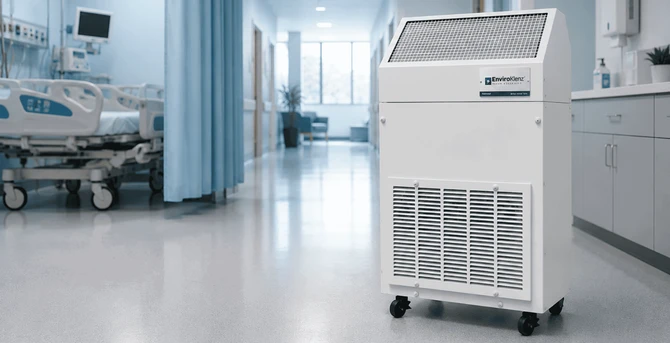
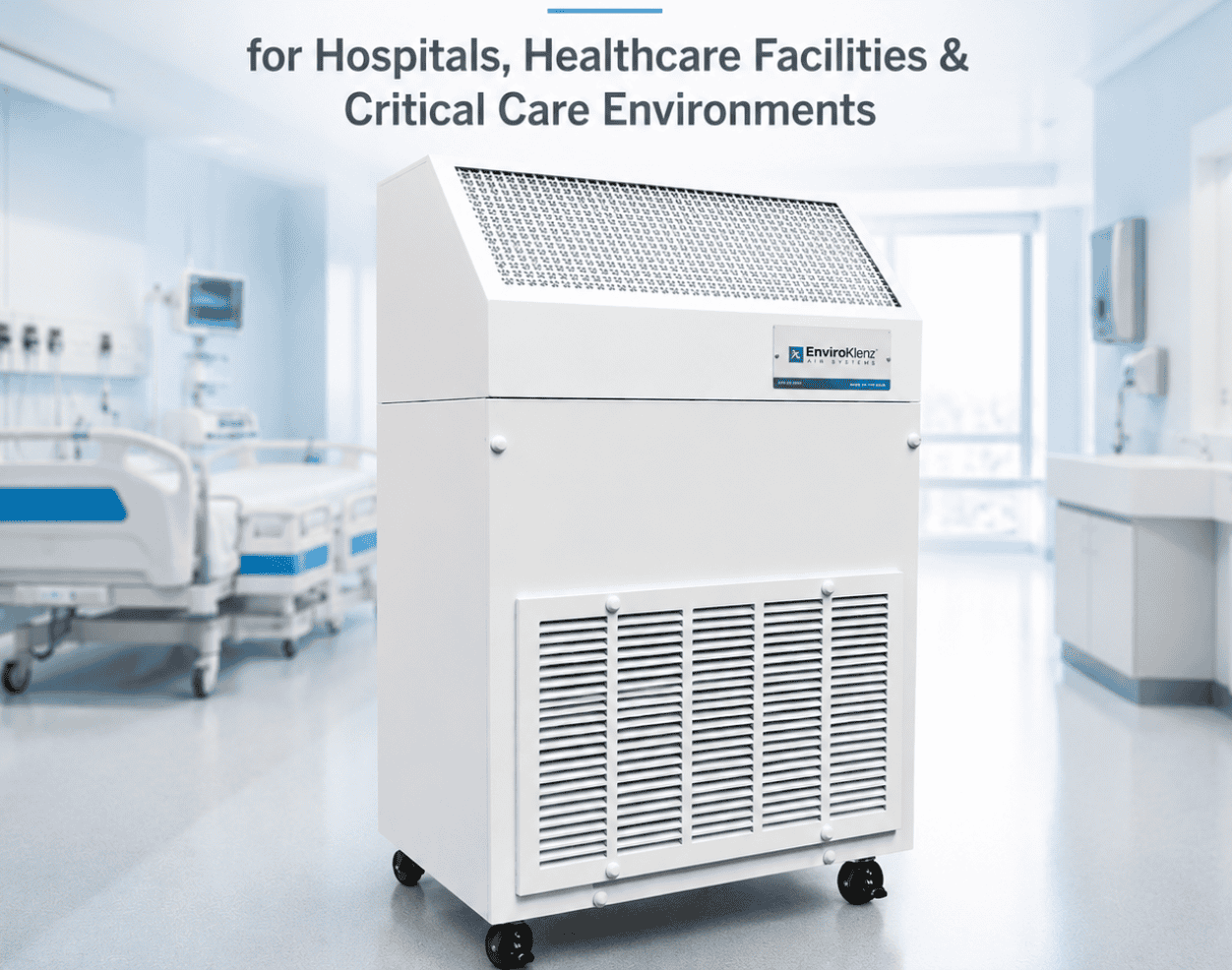
The Envirco Hospi-Gard® IsoClean® 400 is not a standard portable HEPA air cleaner. It is a hospital-grade air cleaning system that operates in three configurations:
- 100% Recirculation — HEPA-filtered air is returned to the room. Ideal for ICRA Class I and II, occupied spaces, and air quality improvement.
- 100% Exhaust (Negative Pressure) — All air is exhausted out of the containment zone. Meets ICRA Class III and IV negative pressure requirements.
- Partial Exhaust — A blend of both. Useful for transitional spaces or when full negative pressure is not yet established.
Key specifications:
- Airflow: Up to 400 CFM of HEPA-filtered air
- HEPA efficiency: 99.99% at 0.3 microns (aluminum frame — hospital grade)
- Air changes: More than 6 air turnovers per hour in a 500 sq. ft. space
- Operation: Quiet, designed for occupied healthcare environments
- Maintenance: Simple filter access, low replacement cost
- Made in the USA
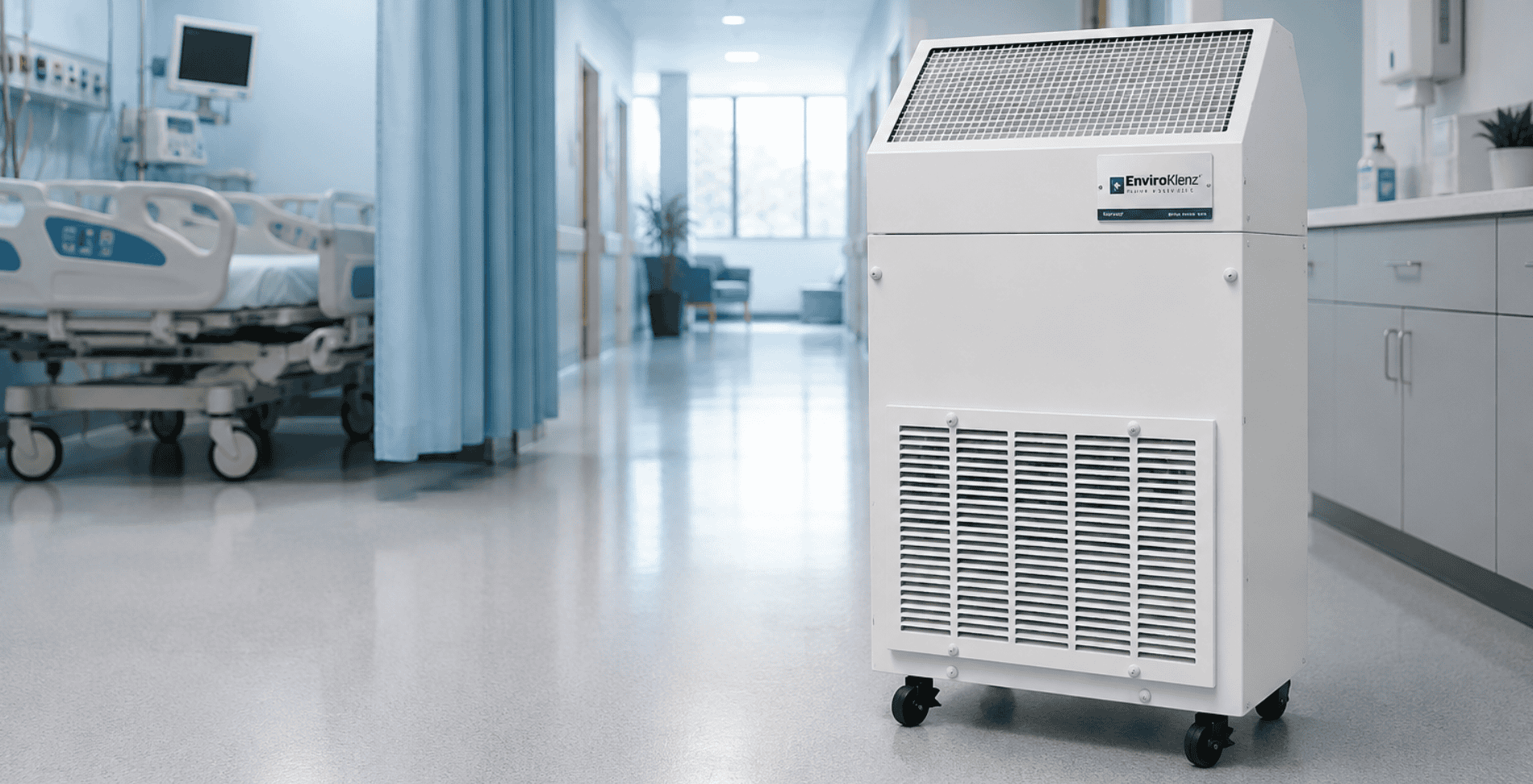
The IsoClean 400 draws unfiltered air into the lower portion of the unit, through the pre-filter, then through the HEPA filter, and discharges clean air at high velocity from the top exhaust grille — creating a low-to-high circulation pattern that sweeps the full room height. This is not incidental design. It is engineered specifically for healthcare spaces where clean air delivery coverage matters.
IsoClean 400 vs. IsoClean 400UV: Which Should You Buy?
Spycor Environmental carries both configurations of the Envirco Hospi-Gard IsoClean 400:
Envirco Hospi-Gard® IsoClean® 400 — Freestanding, 120V, 99.99% Efficiency
The standard unit. Everything described above — 400 CFM, 99.99% HEPA, three operating modes, negative pressure capable, quiet, US-made.
Best for: Healthcare construction contractors, hospital facilities teams, infection control coordinators, abatement contractors working ICRA-designated projects.
Envirco Hospi-Gard® IsoClean® 400UV — Freestanding with UV-C Light, 120V, 99.99% Efficiency
Everything in the standard IsoClean 400 — plus an integrated UV-C germicidal light that provides an additional layer of biological pathogen inactivation beyond what HEPA alone captures.
Best for: High-risk patient areas, immunocompromised patient wings, operating room corridors, oncology units, or any ICRA Class IV project where biological risk is elevated.
Recommendation: If your work is primarily construction dust and particulate control, the standard IsoClean 400 covers you completely. If you are working near oncology, transplant, or ICU patients — or your facility's infection control officer has flagged biological contamination risk — the 400UV is worth the additional investment.
Who Should Buy the IsoClean 400?
This is not a general-purpose air purifier. It is a professional-grade, hospital-certified unit built for specific buyers:
Healthcare Construction Contractors Running ICRA-designated renovation projects inside occupied hospitals, clinics, or medical office buildings. You need a unit that can flip between recirculation and negative pressure depending on the phase of your project.
Hospital Facilities Managers Managing in-house maintenance, repairs, or small renovation work inside the facility. The IsoClean 400 gives your team the flexibility to handle Class I through III projects without outsourcing negative pressure setup.
Infection Control Practitioners (ICPs) Specifying or approving equipment for construction projects in your facility. The IsoClean 400's 99.99% HEPA efficiency exceeds ASHRAE's recommended MERV 13 minimum for airborne pathogen control.
Environmental Abatement Contractors Working in healthcare settings where standard construction negative air machines may be too loud, too large, or not appropriate for occupied environments.
Ready to Order?
Both units are in stock at Spycor Environmental with fast shipping and technical support available:
- Envirco Hospi-Gard® IsoClean® 400 → Order at Spycor Environmental
- Envirco Hospi-Gard® IsoClean® 400UV (with UV-C) → Order at Spycor Environmental
Questions about which configuration fits your project? Call Spycor Environmental at 1-877-293-0784 or email support@spycor.com.
Frequently Asked Questions
Can a portable HEPA air cleaner replace a negative air machine for ICRA Class III projects?
Only if it is capable of operating in full exhaust (negative pressure) mode — not just recirculation. A standard portable HEPA air cleaner that only recirculates air does not create negative pressure and does not meet ICRA Class III requirements. The IsoClean 400 is specifically designed with a full exhaust mode for this reason.
What is the difference between 99.97% and 99.99% HEPA efficiency?
Both capture particles at 0.3 microns, but 99.99% efficiency means the filter allows only 1 particle through per 10,000 — compared to 3 per 10,000 at 99.97%. In immunocompromised patient environments, that difference matters. The IsoClean 400 uses a 99.99% aluminum frame HEPA filter — hospital grade by design.
How many air changes per hour does the IsoClean 400 provide?
More than 6 air changes per hour in a 500 sq. ft. space. CDC guidelines for airborne infection isolation rooms recommend a minimum of 12 ACH — for larger spaces or higher-risk requirements, pair two units or step up to the IsoClean 800.
Is the IsoClean 400 loud enough to disrupt patient care?
No. It is engineered specifically for quiet operation in occupied healthcare environments — unlike standard construction-grade negative air machines which are typically too loud for patient-adjacent areas.
Does the IsoClean 400 require professional installation?
No. It is freestanding, portable, and plug-in — 120V standard outlet. Setup takes minutes, and the three operating mode configurations are straightforward to switch between.
What is the difference between the IsoClean 400 and IsoClean 400UV?
The 400UV adds an integrated UV-C germicidal light to the standard unit. UV-C inactivates biological pathogens — viruses, bacteria, mold — at the DNA level, providing a second layer of protection beyond HEPA mechanical filtration. It costs $308 more and is recommended for the highest-risk patient environments.